First. What makes a good story? Is it an extraordinary event, an interesting character, or an unexpected ending?
Those things certainly help. But there's something even more important: how you tell the story.
You can take an ordinary situation and turn it into something fascinating. Or you can take an extraordinary event and make it sound incredibly boring.
The difference often comes down to a few simple storytelling techniques.
In this guide, I'll show you five practical techniques you can use to make your stories more engaging, whether you're writing a novel, creating content, giving a presentation, or simply telling a friend about something that happened yesterday.
We'll look at examples, explore why each technique works, and, most importantly, learn how to use it.
What Are Storytelling Techniques?
Storytelling techniques are methods storytellers use to capture attention, build interest, communicate ideas, and shape how an audience experiences a story.
They influence not only what we tell people, but how we tell it.
For example, imagine telling someone:
“Dave went on a date, but he forgot his wallet.”
You understand what happened. But it's not particularly exciting.
Now consider this version:
Dave touched his pocket, and his blood ran cold.
His wallet.
He'd forgotten his wallet.
Naomi was about to arrive any second.
Both versions describe the same situation. But the second puts you directly into the moment, lets you experience Dave's panic, and makes you wonder what he's going to do next.
That's what good storytelling techniques can accomplish.
Here are twenty you can start using immediately:
20 Storytelling Techniques
- Grab attention: Start in the middle of something happening.
- Create curiosity: Give your audience a question they want answered.
- Introduce conflict: Put an obstacle between your character and what they want.
- Use specificity: Replace vague descriptions with memorable details.
- Control pacing: Slow down important moments and speed through unimportant ones.
- Show, don't tell: Reveal emotions and personality through actions.
- Build suspense: Make your audience anticipate what happens next.
- Raise the stakes: Make the consequences of success or failure matter.
- Create relatable characters: Give your audience someone to identify with.
- Use dialogue: Let characters reveal information through conversation.
- Create emotional connections: Make your audience feel something.
- Use foreshadowing: Plant clues about what might happen later.
- Add unexpected twists: Surprise your audience without breaking the story's logic.
- Use contrast: Highlight differences to make moments more powerful.
- Build tension: Gradually increase pressure on your characters.
- Give characters clear desires: Make it obvious what they're trying to achieve.
- Use sensory details: Bring scenes to life through sight, sound, smell, touch, and taste.
- Create a satisfying payoff: Deliver on the expectations you've established.
- Use callbacks: Bring back an earlier detail with new meaning.
- Show transformation: Let your characters change through their experiences.
Now let's explore the first five techniques into deeper details, because I think those are particularly interesting. You can also watch the video if you prefer a visual format.
1. Grab Attention: Start in the Middle of Something Happening
The beginning of your story has one important job: give your audience a reason to keep listening.
One of my favorite ways to do this is to start in medias res, a storytelling technique that means beginning in the middle of the action.
Instead of explaining everything that happened before the interesting moment, take your audience directly into it.
Example: Two Ways to Start the Same Story
Version 1: Starting with background information
Aia loved riding motorcycles. She'd been riding for years, and one Sunday morning, she decided to take a trip to the mountains. The weather was beautiful, and she was enjoying the ride.
Version 2: Starting in the middle of the action
Aia leaned into the corner.
Halfway through the turn, she saw a truck coming straight toward her.
In her lane.
Which opening makes you want to know what happens next?
The second version immediately introduces something unexpected. There's danger, uncertainty, and a situation that demands attention.
You don't know where Aia is going or why she's riding a motorcycle. But you don't need to know that yet.
You want to know whether she's going to hit the truck.
Why This Technique Works
When something important is already happening, your audience has a reason to pay attention.
They don't have to wait through paragraphs of background information before reaching the interesting part.
And once they're invested, you can introduce the context they need to understand the rest of the story.
This technique isn't limited to fiction. It works in presentations, business storytelling, conversations, and videos.
How to Use It
Before telling a story, ask yourself:
Where does something interesting actually happen?
Look for a moment when:
Something unexpected occurs.
A character faces a problem.
An important decision must be made.
Something changes.
Try starting there.
You can fill in the necessary background afterward.
Remember: you can have the most incredible story in the world, but if nobody sticks around to hear it, it won't matter.
2. Create Curiosity: Give Your Audience a Question They Want Answered
Curiosity is one of the most powerful tools in storytelling.
And one of the simplest ways to create it is to deliberately leave out a piece of information.
Let me show you.
Example: The Flowers on the Doorstep
Every morning, Aia found a fresh flower on her doorstep.
She didn't know who was leaving them, but it had been happening for three weeks.
Then one morning, there was no flower.
Instead, she found a note.
“I'm sorry.”
Now, wait a second.
Who's leaving those flowers? Why did they suddenly stop? And what exactly are they apologizing for?
You don't know.
And that's the point.
I've given you enough information to understand what's happening, but I've left several questions unanswered.
Your mind starts looking for explanations.
Now imagine I'd told you the same story differently:
Aia's family chauffeur had a crush on her. He was too afraid to tell her, so every morning he left a flower on her doorstep. After three weeks, her father found out and fired him, so he left her a note apologizing.
Same basic story.
But this time, I've already explained everything.
There's no mystery left to solve.
Why Curiosity Works in Storytelling
Curiosity arises when we recognize a gap between what we know and what we want to know.
Storytellers can use that gap to encourage audiences to continue reading, watching, or listening.
Think about mystery movies.
Someone disappears. A strange object appears. A character receives a message that makes absolutely no sense.
We want answers.
And that desire gives us a reason to continue.
But there's an important distinction: curiosity isn't the same as confusion.
If you leave out too much information, your audience might not understand what's happening at all.
The goal is to give them enough information to follow the story while keeping one important question unanswered.
How to Use It
Before telling your story, ask:
What do I want my audience to wonder about?
Then build part of your story around that question.
For example:
Who left the mysterious note?
Why did the character suddenly leave?
What's inside the locked room?
How will someone escape a seemingly impossible situation?
Introduce the question, allow your audience to become invested, and reveal the answer when it matters.
Just make sure you eventually deliver a satisfying payoff. Curiosity can attract attention, but endlessly withholding answers can become frustrating.
3. Introduce Conflict: Put an Obstacle Between Your Character and What They Want
Here's a simple storytelling principle:
Someone wants something, but something stands in their way.
That's conflict.
And conflict is what drives many stories forward.
It doesn't necessarily mean two people fighting. Conflict can be anything that makes it harder for a character to achieve their goal.
Example: Conflict in The Hunger Games
Consider The Hunger Games.
At the beginning of the story, Katniss Everdeen wants to protect her little sister, Prim.
When Prim's name is drawn for the Hunger Games, Katniss volunteers to take her place.
Suddenly, she finds herself in a deadly arena with twenty-three other participants.
Now she has another urgent desire: to survive.
Except that almost everything stands in her way.
Other participants are trying to kill her. The people controlling the Games introduce new dangers. Food, water, and shelter are difficult to obtain. And she doesn't know whom she can trust.
Every time Katniss gets closer to achieving her goal, another obstacle appears.
Those obstacles force her to think, act, make difficult decisions, and face consequences.
And those decisions lead to new problems.
Conflict creates plot.
Without meaningful obstacles, Katniss's journey would be very different.
Conflict Works in Ordinary Stories, Too
You don't need a deadly arena to introduce conflict.
Imagine I told you:
“This morning, I made my bed and rushed to work.”
Not particularly interesting, right?
Now consider this:
“This morning, I was already late, and all I wanted was to make my bed. Except my cat was sprawled across the sheets, blocking everything like she owned the room.”
Suddenly, there's a problem.
Me versus my cat.
It's a tiny conflict, but it creates friction and gives the story somewhere to go.
Will I move the cat? Give up? Be even later?
Even ordinary situations become more engaging when someone encounters an obstacle.
How to Use It
Ask yourself two questions:
1. What does my character want?
2. What's stopping them from getting it?
If you can answer both, you've found the foundation of your conflict.
The obstacle might be another person, a difficult situation, a lack of resources, or even the character's own fears.
The important thing is that the obstacle matters to the character and influences what happens next.
4. Use Specificity: Replace Vague Descriptions With Memorable Details
Your audience can't see what's inside your head.
When you tell a story, you have to help them imagine it.
And one of the best ways to do that is to use specific, concrete details.
Example: Describing a Dirty Hotel Room
Version 1: Vague description
Aia walked into a hotel room. It was old and dirty. She looked around, disgusted. The place was cheap and awful.
You understand the general idea.
But what does the room actually look like?
Version 2: Specific description
Aia opened the door to the hotel room.
A cockroach scurried across the floor and disappeared into the bathroom.
There was a cigarette burn in the pillowcase, and a few yellow stains crept down from the corners of the ceiling.
There might be mold in the walls.
It might make her sick tonight.
Now you can probably picture the room much more clearly.
The cockroach, cigarette burn, and yellow stains create an atmosphere that words like “dirty” and “awful” can't communicate as vividly on their own.
Why Specific Details Make Stories Better
Specific details help your audience build a mental picture.
But they can do more than describe a setting.
They can also reveal personality, communicate emotions, and establish the atmosphere of a scene.
For example:
“Jeremiah was a rich man.”
That's understandable, but vague.
Now consider:
“Jeremiah spent forty thousand dollars on a watch and then forgot it in Meredy's bathroom.”
Suddenly, you get a different impression of Jeremiah.
Not only does he have money, but he may also be rather careless about it.
A single detail can communicate several things at once.
How to Use It
Look for vague words in your storytelling, such as:
Beautiful
Terrible
Expensive
Scary
Rich
Powerful
Then ask yourself: What exactly makes it that way?
Instead of saying a family was rich, tell us they owned an entire skyscraper.
Instead of saying Frederick had authority in the group, tell us that whenever he raised his hand, everyone around the table fell silent.
Give your audience something concrete to imagine.
But don't overload every sentence with details. Choose the ones that reveal something important.
Sometimes, the difference between a forgettable story and a memorable one comes down to just a few carefully chosen details.
5. Control Pacing: Slow Down Important Moments and Speed Through Unimportant Ones
Pacing is the speed at which a story unfolds.
And here's something fascinating about storytelling:
As a storyteller, you can control how your audience experiences time.
A moment that lasts two seconds in real life can occupy an entire page of a novel.
Meanwhile, you can summarize three years in a single sentence.
The trick is knowing when to slow down and when to speed up.
Example: A Motorcycle Accident That Almost Happened
Version 1: Fast pacing
Aia was riding through the city when a street dog suddenly jumped onto the road. She slammed on the brakes, swerved around the dog, and narrowly missed a pole. Somehow, she managed to regain control of her bike and continued riding.
A frightening situation.
But it happens so quickly that we barely have time to experience it.
Version 2: Slower pacing
Aia was charging through the city when something moved at the edge of the road.
A dog.
She slammed on the brakes.
The back tyre slid across the dusty asphalt.
Fuck.
A pole stood directly ahead.
She gripped the handlebars, trying to straighten the bike, but the pole was getting closer.
She felt the wind. She smelled the trash.
Then the rear tyre found grip.
The bike jerked upright, missing the pole by inches.
Same event. Same outcome.
But a completely different experience.
In the second version, we spend more time inside the dangerous moment. We experience the individual movements, sensations, and uncertainty.
That's pacing.
Why Pacing Matters
Not every moment in a story deserves the same amount of attention.
Think about movies.
Sometimes, an important moment unfolds in slow motion. A character turns their head. A bullet travels through the air. Everything seems to stop.
The filmmaker wants you to focus on that moment.
But imagine watching every ordinary action in real time.
A character gets out of bed, walks to the bathroom, brushes their teeth, changes clothes, makes breakfast, washes the dishes, and finally leaves the house.
Unless those actions serve a particular purpose, you probably don't need to see all of them.
The same principle applies to storytelling.
How to Use It
Slow down when something important is happening.
Give your audience time to experience meaningful actions, emotions, decisions, and consequences.
Speed up when the details aren't important.
Summarize transitions, routine actions, and events that don't deserve much attention.
For example, you don't need to describe every movement Aia makes while preparing her motorcycle.
You can simply write:
“She swung her leg across the seat. She was on the main road in a second.”
Pacing isn't about making every story fast.
It's about knowing which moments deserve attention.
How to Combine These Storytelling Techniques
The real power of storytelling comes when you start using these techniques together.
Let's return to Aia, the motorcycle rider.
Imagine a scene where she overhears a group of bikers planning to ride to a dangerous section of highway.
She needs to reach it before them.
We could simply explain what happened.
Or we could tell it like this:
“SNAKE,” a big man said.
He stood under the lights of the parking lot. From her hiding spot, Aia could see them all clearly.
Engines revved.
Dozens of bikes roared to life, and Aia didn't have to wait to see where they headed.
She broke into a run.
Her heart pounded. Her palms tingled.
She swung her leg across the seat. She was on the main road in a second.
SNAKE wasn't a direction. It was a very specific part of a road—the curvy highway toward the mountains.
But motorcycles weren't allowed on toll highways.
How were they going to get in?
Aia twisted the throttle.
She had to get there before they did.
Notice how the five techniques work together:
Attention: We begin with something already happening.
Curiosity: We wonder how the bikers will enter the highway and whether Aia will get there first.
Conflict: Aia needs to beat the other riders, but time and road restrictions stand in her way.
Specificity: The parking-lot lights, roaring engines, and tingling palms make the scene more vivid.
Pacing: We move quickly through Aia's escape but slow down to establish the important problem.
Each technique serves a different purpose, but together they make the story more engaging.
And that's the point.
You don't have to use every storytelling technique in every scene. Instead, think about what your story needs and choose the techniques that will help you achieve it.
Frequently Asked Questions About Storytelling Techniques
What are the most important storytelling techniques?
Five particularly useful techniques are starting with a strong hook, creating curiosity, introducing conflict, using specific details, and controlling pacing. Together, they help storytellers capture attention, sustain interest, and make events easier to imagine.
How can I make my storytelling more engaging?
Start by identifying the most interesting part of your story. Give your audience a reason to care, introduce a problem or unanswered question, and use concrete details instead of vague descriptions. Focus attention on important moments and summarize unnecessary information.
Can storytelling techniques be used outside fiction?
Absolutely. Storytelling techniques can be used in business presentations, marketing, public speaking, social media, personal conversations, and educational content. Anywhere you need to communicate an experience or idea, storytelling can help make it more engaging.
What is the difference between a storytelling technique and a story structure?
Story structure describes how the major parts of a story are organized, such as its beginning, middle, and ending. Storytelling techniques are methods used within that structure to shape the audience's experience. For example, you might use conflict to develop the plot and pacing to make a particular scene more intense.
How do beginners get better at storytelling?
One of the simplest ways is to practice telling the same event in different ways. Try starting at different moments, withholding a piece of information, introducing an obstacle, or replacing vague words with specific details. Compare the versions and notice which one creates a stronger experience.
Final Thoughts: Good Storytelling Is About How You Tell It
You don't need an extraordinary experience to tell a good story.
A forgotten wallet. A flower on someone's doorstep. A cat refusing to move off your bed.
Even the most ordinary situations can become interesting when you know how to tell them.
Start where something happens. Give your audience a question they want answered. Introduce obstacles. Choose memorable details. And learn when to slow down or speed up.
Above all, remember that storytelling is a skill.
And like any skill, it gets better with practice.
Want to Learn More About Storytelling?
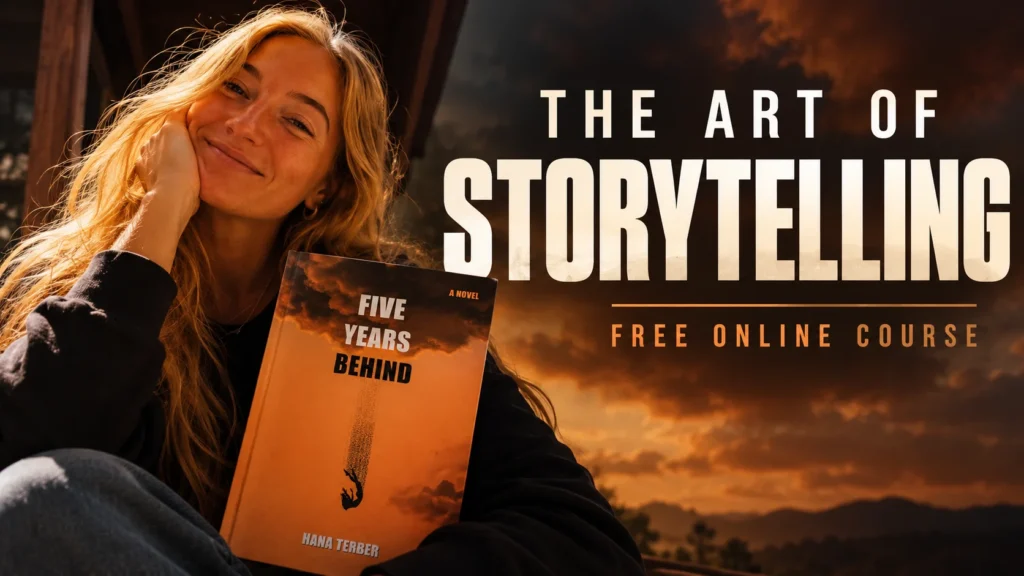
I'm Hana, a novelist and the author of Five Years Behind. I spent three years writing my first novel, and along the way, I learned just how much the way we tell stories matters.
I now share practical storytelling lessons, original examples, and writing techniques on my YouTube channel.
You can watch my video on these five storytelling techniques or explore my free storytelling course to learn more about character, desire, conflict, stakes, structure, emotion, and delivery.
And if you're curious about Aia, the motorcycle rider from our examples, she's the protagonist of my second novel, which I'm currently writing.
Have fun telling stories.