Lesson 1
I'm Hana, and this article is part of my free Storytelling Online Course series. You can find the whole course here, or on YouTube. In this lesson, we'll talk about CHARACTERS! To follow the lesson, watch the video, or read the article below.
Video: Storytelling Pillar #1
The First Pillar of Storytelling: Character
Then she shoved her hands into her pockets and walked away.”
Now, why did you care about what happened in that story?
I would say because you cared, at least a little bit, about who it was happening to.
Now imagine if instead I told you this:
“Kiara stood in front of a beautiful red dress in a shop window. She really wanted it, but she was a hardworking and ambitious person, so she knew that spending the money on her business would be the responsible thing to do. She decided not to buy the dress and walked away.”
Technically, I told you the same thing.
But I don’t know about you—this Kiara is a little bit boring.
So what’s the difference?
Why Do We Care About Some Characters?
Character is the first pillar of storytelling.
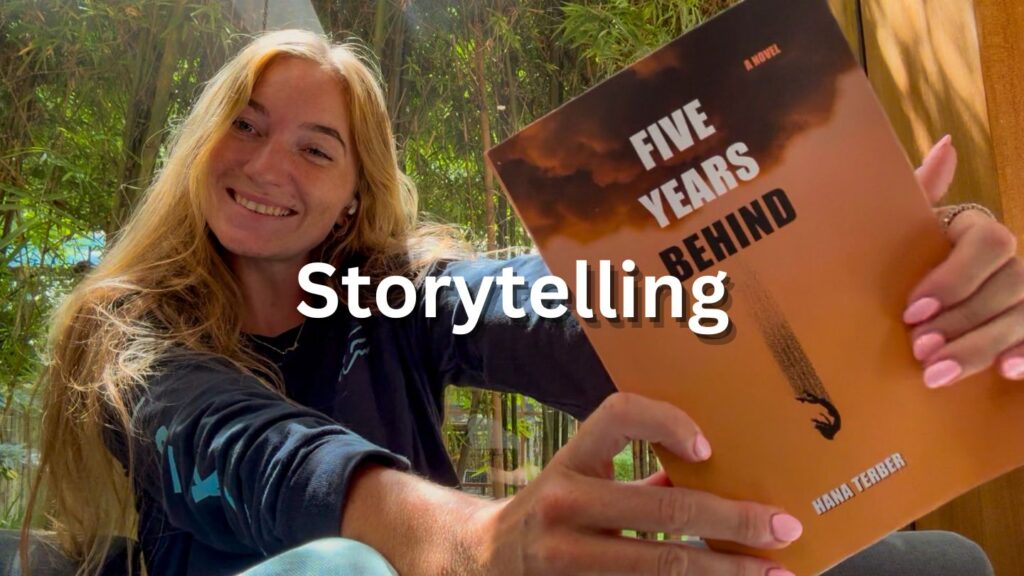
I spent the last three years learning storytelling while writing my novel, Five Years Behind, and one of the biggest things I learned was just how much a story depends on who we experience it through.
So let’s go back to Kiara.
What do we actually know about her from those two short story snippets?
The second example literally tells you who Kiara is. It spills out her whole thought process. She is hardworking. She is ambitious. She wants to be responsible.
But did you really feel connected to her?
I personally didn’t.
From the first snippet, however, you know that Kiara is hardworking, ambitious and competitive. She’s probably a little insecure about her brother, and she’s willing to sacrifice a lot to get what she wants.
But here’s the important part:
I never actually told you any of this.
You felt it from the way the story was told and from the choices the character made.
In both snippets, I introduced Kiara to you. But I did it in two very different ways.
The first makes you care about her.
The second makes you think: Okay. That’s some girl who wants a dress.
Your Main Character Is the Bridge
Having a main character is essential to storytelling because your main character is your bridge between your audience and the experience you want to give them.
And your main character doesn’t necessarily have to be a person.
It usually is, but it can be almost anything.
It could be a dog. In Five Years Behind, I tell a tiny story at a business conference where the main character is literally a space heater. There are even novels told from the perspective of animals.
What matters is that you make us care enough to follow them.
Because we need somebody—or something—to care about.
That’s the core idea:
Give me someone I can follow.
Events only matter to us when they happen to somebody we’re invested in.
What you ultimately want your audience to feel is:
Okay. I want to know what happens to this person.
Does a Main Character Have to Be Relatable?
Not necessarily.
Writing a compelling main character can be difficult, especially when you want your reader to relate to them. But I don’t think every main character—or every character in general—needs to be relatable in a positive way.
I try to make Kiara relatable in many ways.
But there are other characters in my book you’re absolutely not supposed to relate to, especially at the beginning.
A character doesn’t always have to make us think, That’s me.
They should, however, make us feel something.
Curiosity. Sympathy. Anger. Fascination. Frustration. Admiration.
Something that makes us want to keep watching them.
Five Questions for Writing a Better Character
Here’s a very simple way to start building a compelling character.
Ask yourself:
- What do they want?
- Why do they want it?
- What makes them vulnerable?
- What makes them specific or human?
What do their choices reveal about them?
If you can answer those five questions, you’re much more likely to create a character your audience wants to follow.
And if I had to sum up this entire storytelling pillar in one sentence:
A character becomes interesting when we know enough about them to care about what happens next.
That’s it.
Once we have somebody we care about, however, we need something else:
We need to know what they want.
And that brings us to the next storytelling pillar: Desire.