Course Introduction
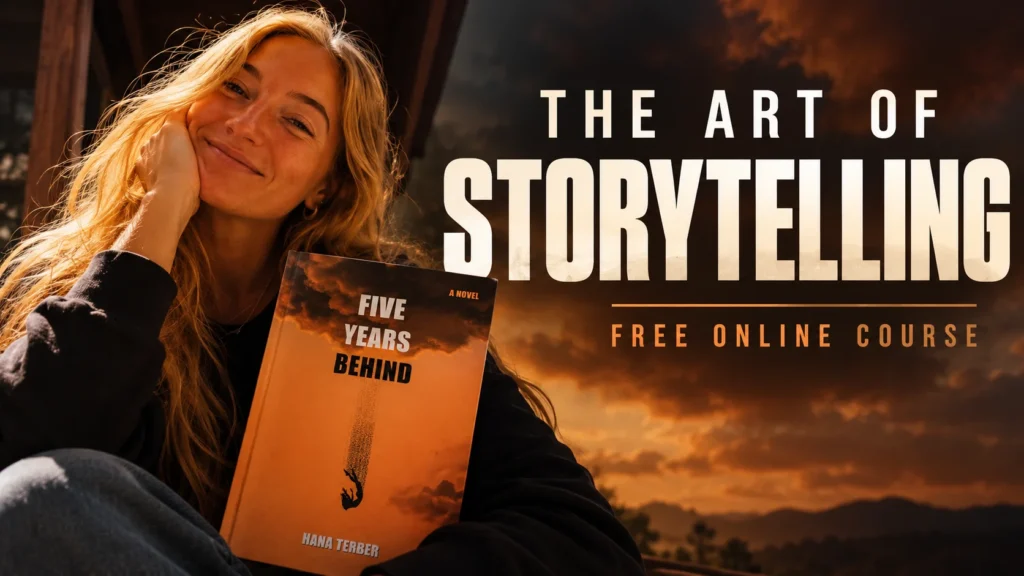
Hi guys! I'm Hana, and The Art of Storytelling is my free online course that will (hopefully) turn you into a master storyteller.
In this course, I'm going to be guiding you through seven very simple and easy-to-follow, FREE lessons about storytelling. You can find the whole course on YouTube, or follow the structure here on Bookopotamia. Watch all the videos, or if you prefer text, you can follow the course via these written articles.
Now let's dive in.
VIDEO: The Art of Storytelling Introduction
The Course: 7 Essential Pillars of Great Storytelling
What makes a good story? Why do some stories capture our attention, make us care about people who don't even exist, and stay with us long after they're over?
The answer isn't necessarily a complicated plot, an extraordinary character, or a surprising ending.
At its core, storytelling is about making people care about whatever it is you're trying to say.
And there's a difference between giving someone information and telling them a story.
Let's look at an example.
What Makes Something a Story?
“A girl gets a ticket to a conference.”
Okay. That's information.
But what if I told you that the ticket came from her brother? A brother who has screwed her over countless times. A brother she doesn't trust one bit. She has every reason to turn the invitation down. But it's not just any conference. It's a massive business summit that could open the door to the life she's always dreamed of.
Now she's standing at the edge of a choice.
Does she go or not?
Suddenly, we have something much more interesting than a girl receiving a ticket. We have a character who wants something, an obstacle standing in her way, and a decision that could change her life. And you're probably curious about what happens next.
That's the power of storytelling.
The 7 Essential Pillars of Storytelling
Over the three years I spent writing my first novel, Five Years Behind, I made more storytelling mistakes than I can count.
I learned an enormous amount along the way, and eventually I realized that many of the lessons I'd learned could be organized into seven fundamental storytelling pillars.
These pillars became the foundation of my free online course, The Art of Storytelling.
They're not strict rules every story must follow. They're simply seven ways of looking at storytelling that can help you understand why a story works—or why something might be missing.
Let's briefly introduce each of them.
1. Character — Who Is the Story About?
The question to ask: Who is this story about?
2. Desire — What Does the Character Want?
The question to ask: What does my character want?
3. Conflict — What's Standing in the Way?
The question to ask: What's stopping my character from getting what they want?
4. Stakes — Why Does It Matter?
The question to ask: Why does any of this matter?
5. Structure — How Does the Story Develop?
The question to ask: Where is this story going, and how does one event lead to another?
6. Emotion — What Should the Audience Feel?
The question to ask: What am I trying to make my audience feel?
7. Delivery — How Is the Story Told?
The question to ask: Am I telling this story in the most effective way—or in the way I want to tell it?
How to Use These Seven Storytelling Pillars
Whenever you're working on a novel, screenplay, short story, marketing campaign, or even a simple anecdote, try asking yourself:
- Character: Who is this about?
- Desire: What do they want?
- Conflict: What's stopping them?
- Stakes: Why does it matter?
- Structure: Where is the story going?
- Emotion: What should the audience feel?
Delivery: How am I telling it?
If something isn't working, these questions can help you identify what's missing.
Maybe your character doesn't want anything clearly enough. Maybe the conflict isn't strong enough. Maybe the stakes aren't meaningful, or the delivery doesn't create the emotional experience you're hoping for.
Sometimes, understanding the problem is the first step toward fixing it.
Learn Storytelling: A Free Online Course
I created The Art of Storytelling to share what I learned during the three years I spent writing my debut novel, Five Years Behind.
The course consists of seven video lessons, each dedicated to one of the storytelling pillars.
We'll explore what each pillar means, why it matters, and how you can use it in your own storytelling, with simple explanations and practical examples.
Whether you're an aspiring novelist, screenwriter, content creator, marketer, or simply someone who wants to tell better stories, you're welcome to follow along.
My goal isn't to tell you exactly how to write.
It's to help you understand the elements that make stories work, so you can make your own creative decisions with more confidence.
Because storytelling is individual. There isn't just one correct way to tell a story.
The goal is to learn how to tell your story the way you want to tell it.
Watch The Art of Storytelling — Free Online Course on YouTube
Start with Lesson 1: Character, and work your way through all seven pillars.
Happy storytelling!
Hana Terber
Discover Five Years Behind on Amazon | Visit Hana's website