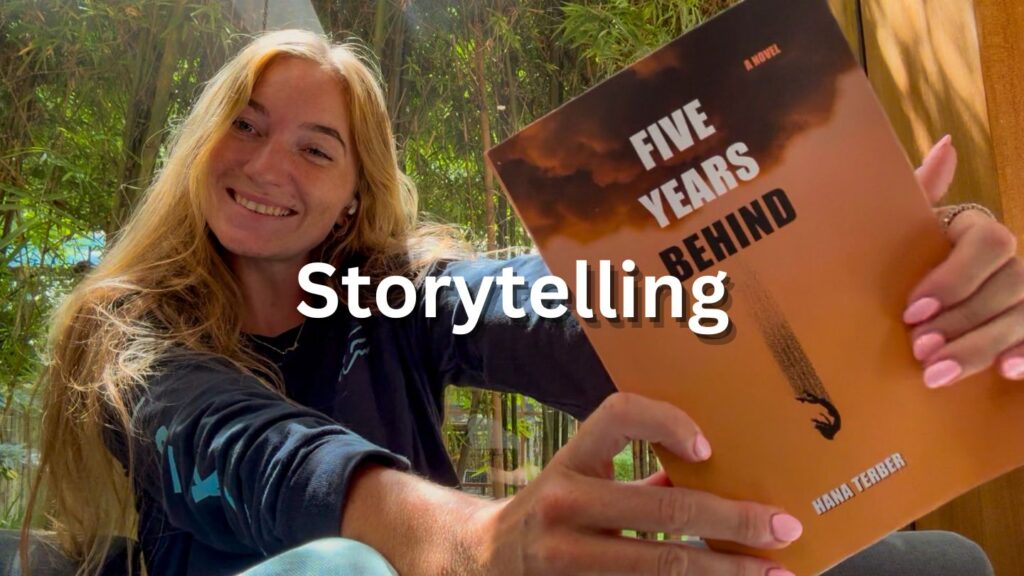
I love storytelling. It's such a powerful skill. Once you unlock that, an entire new realm opens up to you. A realm or of fun and attention. People listen, people want to hear more, people ask questions. It's almost like magic.
I learned storytelling accidentally, no joke, when I decided to write my novel in 2023. One morning I woke up driven by a new creative calling, and I had no idea I'd end up spending 3 years in hell (=writing that book), and then walk out with something extremely precious: the power of storytelling.
Video: I Spent 3 Years Learning Storytelling
Storytelling framework
Before I start, let me give you a storytelling framework you can follow. I'll try to give you a simple one, because once you start to overcomplicate it, you overthink it, and it becomes hard to follow. Try just something easy. Such as:
- WHO — Who is the story about? (Pick a main character — me, you, he, she, my neighbor, my dog)
- WANT — What do they want? (My dog wants the steak sitting on the kitchen counter.)
- WHY — Why does it matter to them? (Because he loves steak almost as much as he loves breaking the house rules.)
- PROBLEM — What gets in their way? (The steak is too high for him to reach.)
- STRUGGLE — What do they do about it? (He scratches at the cabinet and tries climbing onto a chair.)
- STAKES — What happens if they fail? (I’m about to come back. He hears my footsteps. He knows I'll put the steak in the fridge.)
- CLIMAX — What is the decisive moment? (He finally gets onto the chair and makes a jump for the steak.)
- OUTCOME — What happens? (He gets it. He even eats the entire thing before I come back.)
- CHANGE — How are they or their situation different afterward? (He got what he wanted. I no longer have dinner. He knows I'm angry, but that's another story.)
In its simplest form: someone wants something → something gets in the way → they try to overcome it → something changes.
Now, for the real info. Let's talk about it. Let me tell you everything I know about storytelling.
What Is Storytelling?
Storytelling is the act of communicating events, experiences, or ideas through a narrative. At its simplest, something happens, and you guide someone through it. In other words it's:
- Sharing events as a story
- Usually follows a character or subject
- Something happens or changes
- Often involves a goal, problem, or conflict
- Gives events context and meaning
- Can be fictional or based on real events
Why Is Storytelling Important?
Easily? It helps people understand, remember, and care. I'm speaking from experience. Powerful storytelling turns facts and ideas into emotional experiences.
- Helps people understand ideas
- Makes information easier to remember
- Creates emotional connection
- Helps us relate to other people's experiences
- Keeps people interested
- Can communicate complicated ideas simply
- Gives meaning and context to information
What Makes a Good Story?
Have you ever talked to somebody who made you widen your eyes, asking, “And what happened next?” That is the power of storytelling. Making people want to know what happens next. It usually gives you someone to care about, something they want, and something standing in their way. It can be:
- An interesting character or subject
- A clear goal or direction
- Conflict or obstacles
- Something meaningful at stake
- Curiosity about what happens next
- Emotional involvement
- Change or development
- A satisfying payoff
The Core Elements of Storytelling
This can be beautifully demonstrated on novels (and you know I love that!). When you read a novel, you have a protagonist, an antagonist, a goal, conflict, stakes, setting, change. Most stories need the same. The exact ingredients vary, but something usually needs to happen to someone for a reason.
How Story Structure Works
Structure is simply the order in which you reveal the story. Usually, you establish a situation, disrupt it, let complications build, reach a major turning point, and show what happens because of it.
How to Make a Story Interesting
Hm. Let me try to give you some tips. Try to create curiosity. Give the audience questions they want answered, introduce conflict or uncertainty, and avoid telling them everything before they need to know it. Introduce conflict. Make something matter. Add uncertainty. Use surprises. There's just so much you can try. Give characters difficult choices. Reveal information gradually. Remove unnecessary information. Keep the story moving. And if you want to practice, I can highly recommend writing a novel! It's fun, trust me.
How to Create Emotion in Storytelling
Emotion usually comes from experiencing what something means to a character rather than simply being told how they feel. So try to:
- Give the audience someone to care about
- Make the character want something
- Make their motivations understandable
- Put something important at risk
- Create hope, fear, tension, loss, relief, etc.
- Let characters react naturally
- Show emotion rather than constantly naming it
- Make events have consequences
Storytelling Techniques That Work
Different techniques work for different stories. Use conflict, suspense, foreshadowing, specific details, strong dialogue, contrast, unanswered questions, and showing instead of explaining.
Common Storytelling Mistakes
There's a lot. The worst ones are:
- Overexplaining
- Starting too early
- Weak conflict
- Low stakes
- Repeating the same information
- Predictable events
- Flat characters
- Unnecessary scenes
- Slow pacing
- Explaining emotions instead of showing them
- Giving away information too soon
How to Become a Better Storyteller
Honestly? Practice. Tell stories, study other stories you like, and figure out why they work. Practice cutting what isn't necessary, creating curiosity, and paying attention to where your own attention drops when you reread or rewatch something. I spent years learning it, and I think I'm still on the way. So don't be too hard on yourself. Watch how people react and try to improve day by day.